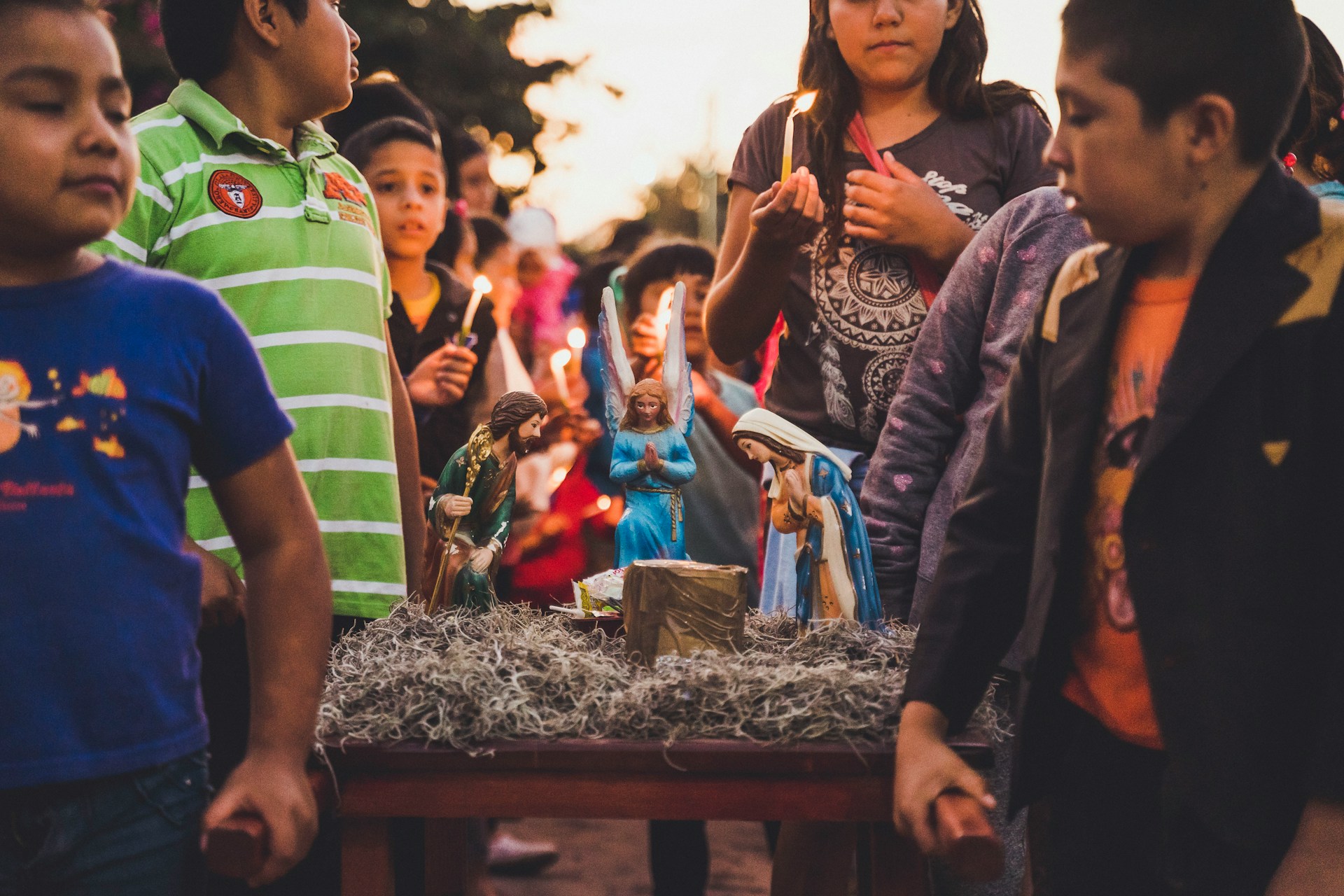
Picture a street in Mexico on the evening of December 16. A group of neighbors stands outside a front door holding candles and small figures of Mary and Joseph, singing a request for lodging. From inside, other voices sing back that there is no room. After a few verses of this the door opens, and the whole street files in for hot fruit punch, tamales and a piñata. The next night it happens again, at a different house.
That ritual is Las Posadas, and it says a lot about Mexico Christmas traditions in general: the season starts well before December 25, runs long after it, and is spent mostly outdoors or in somebody else’s living room. Below are the customs worth knowing, the dishes that actually get served, how the calendar works from December 12 to February 2, and a few notes for anyone planning to be there.
Short version: Mexican Christmas centers on Las Posadas (December 16–24), piñatas, Nacimiento nativity scenes, Pastorela plays and a late family dinner on Nochebuena, December 24. Many people count the wider season from the Virgin of Guadalupe on December 12 to Candelaria on February 2.
Mexico’s Christmas calendar: December 12 to February 2
December 25 is the quiet part. Most of the action is spread around it.
December 12
Day of the Virgin of Guadalupe
Not Christmas itself, but the day many people treat as the start of the party season. The city government counted more than 11 million arrivals at the Basilica in Mexico City by early morning on December 12, 2025.
December 16–24
Las Posadas
Nine evenings of processions and neighborhood parties.
December 24
Nochebuena
The big family dinner, and the night the Niño Dios goes into the nativity scene.
December 25
Christmas Day
Rest, visits and reheated leftovers.
January 6
Día de Reyes
Three Kings Day: the Rosca de Reyes is sliced, and gifts are opened in many homes.
February 2
Día de la Candelaria
Tamales and atole, paid for by whoever found the figurine in the Rosca.
Mexicans joke about the stretch between December 12 and January 6 as the Maratón Guadalupe-Reyes, the Guadalupe–Kings marathon, because the parties stack up until the Rosca closes it out.
Las Posadas: nine nights of asking for shelter
Posada means “inn.” The ritual re-enacts Mary and Joseph looking for somewhere to stay in Bethlehem, and it runs for nine evenings, December 16 through 24. The count is often tied to the nine months of pregnancy.
The format is simple. Guests split into two groups. The “pilgrims” stay outside, singing and carrying figures of Mary and Joseph. The “innkeepers” answer from inside and refuse them, verse by verse, until someone relents. Then the party starts: ponche, tamales, a piñata, and often small bags of fruit and sweets for guests to take home.
A neighborhood posada procession, with figures of Mary and Joseph leading the way.
The history is more layered than “a Catholic tradition.” Mexico’s national institute of anthropology and history, INAH, notes that the origin of the posadas is attributed to the Augustinian convent at Acolman, near Mexico City, where in 1587 the prior, Fray Diego de Soria, obtained a bull from Pope Sixtus V for a series of Christmas masses. By the late 1700s, according to a Catholic.net history, the posadas had split from those masses and become neighborhood and family celebrations.
Some accounts add that the friars reused an Aztec midwinter festival, Panquetzaliztli, dedicated to the god Huitzilopochtli, swapping the characters but keeping the date. The same history says only that this probably happened, and that hedge is a real one: how much is documented and how much is retrospective storytelling is still argued over.
Public posadas exist in parishes, museums and town squares, but most happen in courtyards and on streets among neighbors. The FAQ at the end covers how a visitor can join one.
The piñata and its seven points
The Christmas piñata is a star, not a donkey, and it has seven points. In the traditional religious reading, the points stand for the seven deadly sins, the blindfold for faith, and the fruit and sweets that spill out for the reward of resisting temptation. That is one tradition’s interpretation, not a rule, and the modern piñata (shaped like a superhero or a soccer ball) carries none of it.
The traditional star piñata: seven points, bright paper fringe.
Where piñatas come from is murkier than the tidy version. A craft catalog from the State of Mexico calls the origin “diverse” while pointing to Acolman, the same town tied to the posadas, as the place with evidence from 1587. So the star piñata and the posada may well have grown up together.
Nacimientos: the nativity scene as a craft project
A Nacimiento (literally “birth”) is the Mexican nativity scene, and many homes set one up alongside the tree. Figures can be clay, wood or textile, depending on local craft traditions, and some families build entire landscapes with rivers, bridges and miniature villages around the stable.
The Niño Dios figure goes into the manger on December 24. Per UNAM’s description of the custom, it comes out again on February 2, so the scene often stays up well past New Year.
A handcrafted Nacimiento with houses, animals and a landscape around the stable.
Pastorelas: shepherds, a devil and a lot of jokes
A pastorela is a Christmas play about shepherds walking to Bethlehem while the devil does everything he can to stop them. Angels step in, good wins, and in between there is slapstick, music and topical satire. The form descends from the religious plays missionaries used in colonial New Spain, and the writer José Joaquín Fernández de Lizardi wrote a popular one in the early 1800s.
The best-known modern version is in Tepotzotlán, a colonial town northwest of Mexico City. Its pastorelas have been staged since the 1960s in the courtyard of a former Jesuit college that now houses the Museo Nacional del Virreinato, with local residents playing the shepherds. Dates shift from year to year, so check the museum’s calendar before building a trip around it.
Nochebuena: the flower the world calls poinsettia
In Mexico the poinsettia is flor de Nochebuena, “Christmas Eve flower,” and it is native here. Its Nahuatl name, cuetlaxóchitl, is usually glossed as “flower that withers,” though other sources translate it as “leather flower.” Nobody seems to settle the argument.
The red “petals” are actually bracts, which are modified leaves. The true flowers are the small yellow clusters in the center. Franciscan friars in Taxco, Guerrero, began using the plant in Nativity celebrations in the 1600s, partly because it blooms at exactly the right time of year. In the 1820s, Joel Roberts Poinsett, the first U.S. ambassador to Mexico, took plants home from the Taxco area, which is how the English name came about.
Nochebuena, the poinsettia, is a Mexican native.
It is also a real industry. Figures from Mexico’s agriculture ministry, as reported by Meteored, put output at around 16 million plants a year, with the state of Morelos supplying more than a third.
What’s on the table: Nochebuena dinner and the day after
There is no single Mexican Christmas menu. UNAM’s food coverage says outright that the dinner varies by region and family. In general, it is served late on December 24, often after a church service, and it can go on for hours. Here is what you are most likely to meet.
A Nochebuena table: bacalao, romeritos and a pot of hot ponche.
Bacalao a la vizcaína. Salted cod stewed with olive oil, tomato, almonds, chiles güeros, olives and potatoes. It arrived with the Spanish, and every family claims the original recipe.
Romeritos. Despite the name, not rosemary but a leafy green (a quelite), usually served in mole with potatoes and dried-shrimp patties, and often beside the bacalao.
Turkey, pork leg and mole de guajolote. The main-course alternatives to fish.
Ponche navideño. A hot fruit punch of tejocote, guava, sugarcane, apple, tamarind and prunes, served at posadas as well as at dinner. The recipe changes from family to family, and some add liquor.
Tamales and buñuelos. Tamales appear at posadas, at dinner and again on February 2. Buñuelos are thin fried pastries with sugar or syrup.
Ensalada de manzana. A creamy apple, pineapple, walnut and raisin salad that many families treat as dessert.
The morning after has its own name: recalentado, the reheated leftovers. Romeritos often turn up at both the dinner and the recalentado.
Three Kings Day, the Rosca and the tamale debt
On January 6, Día de Reyes marks the Three Wise Men bringing gifts. In many homes children open presents that day, though families differ on whether the gifts arrive on Christmas, from Santa, or with the Kings.
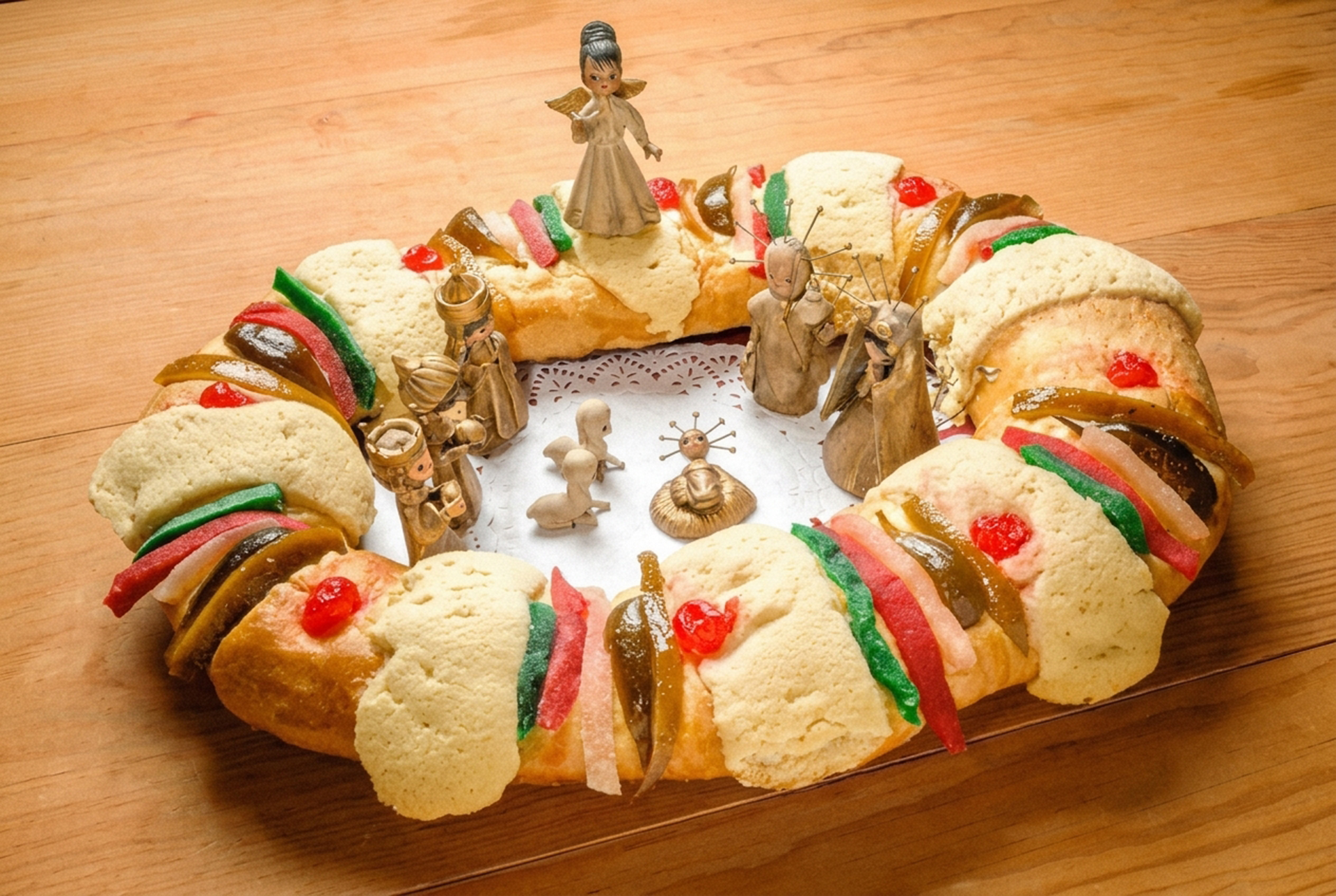
The centerpiece is the Rosca de Reyes, a ring-shaped sweet bread topped with candied fruit, with small baby Jesus figurines baked inside. Whoever finds one becomes the child’s godparent for the year. According to a UNAM document on the custom, that means taking the figure to church for a blessing and hosting tamales and atole on February 2.
A Rosca de Reyes, whole and sliced, with the hidden figurine visible.
Why February 2? It is 40 days after Christmas, the day that, in Catholic belief, Mary took the infant Jesus to the temple. Some accounts also link the tamales to a pre-Hispanic maize ritual, with UNAM sources describing offerings of maize at this dry time of year, so the dish may be older than the church calendar.
Planning a December trip around the traditions
The most predictable crowd is around the Basilica of Guadalupe on December 11–12. After 2025’s count of more than 11 million arrivals, expect road closures and transport changes nearby. December 12, 2026 falls on a Saturday.
Posadas and pastorelas are run by individual parishes, museums and towns, and some are announced only a few days ahead. Check opening hours for December 24–25 and January 1 before counting on a particular restaurant or museum.
That is also when a local data connection earns its keep, because you will be checking maps, ride apps and event posts on the fly. ByteSIM’s Mexico eSIM runs on Telcel and AT&T, supports hotspot, and doesn’t require ID or registration. Most plans are data-only, so your WhatsApp number stays the same and calls go through apps; a few plans add minutes. Daily and total-data plans drop to 128 kbps once the high-speed allowance is used, and you need an unlocked, eSIM-compatible phone (see the compatible devices list). Install it on Wi-Fi before you fly. Most plans start counting when the phone first connects in Mexico.
MEXICO eSIM
Heading to Mexico this December?
Telcel and AT&T on one eSIM, hotspot included, no ID needed. Install it before you fly; on most plans it starts when you land.
Do Mexican families use Santa Claus and Christmas trees?
Often both, next to the Nacimiento. Who delivers the presents differs from home to home: some families open gifts on Christmas Eve or Christmas Day with Santa or the Niño Dios in the story, others wait for the Three Kings on January 6, and plenty do some of each.
Can a visitor join a posada?
Yes, if you pick the right kind. Parish, museum and town-square posadas are open to the public and are the easy way in; the Museo Nacional del Virreinato in Tepotzotlán, for example, runs a seasonal program of posadas and pastorelas. Neighborhood and family posadas are private, so a local host’s invitation is the way in.
Are Las Posadas celebrated outside Mexico?
Yes. The tradition is also kept in parts of Central America and by Latino communities in the southwestern United States, though dates and customs vary by place.
If I only try one Mexican Christmas dish, which should it be?
Tamales are the safest bet: they appear at posadas, at Christmas Eve dinners and again on February 2, so you get the most chances to find them. Romeritos and bacalao are more specifically festive, so look for them on December menus.