
Stream the 2026 Asian Games Live: Your Nagoya Travel Guide & Best Japan eSIM Options
Jul 07,2026 | Milo
Part 1: Introduction: Get Ready for the 20th Asian Games
The world’s eyes are turning toward the vibrant streets of Nagoya and the scenic beauty of Aichi Prefecture. As the 20th Asian Games prepare to take center stage, millions of international travelers are gearing up for a spectacle of athleticism and culture that only Japan can deliver. From the roar of the crowds in state-of-the-art stadiums to the serene experience of local Japanese landmarks, this event promises to be a once-in-a-lifetime journey.
However, even for a seasoned traveler, "no connection" is the ultimate travel nightmare. While Japan is world-famous for its high-tech reputation, navigating the intricate subway systems of Nagoya or finding your way to a specific competition venue can be incredibly difficult without a reliable, high-speed internet connection.
Whether you are trying to find the quickest route to the stadium or attempting to live-stream a historic gold-medal moment, you shouldn't have to worry about your data. Unfortunately, many visitors find that public Wi-Fi in Japan is often frustratingly slow or requires complex, language-intensive registration processes just to log in. Even worse, relying on your home carrier can lead to "bill shock" from exorbitant international roaming charges.
That is where this guide comes in. We have created this comprehensive, high-value handbook to ensure your experience at the 2026 Asian Games is seamless and stress-free. We will cover everything from essential venue highlights to the most important travel tip of all: how to stay connected the moment you land using a high-speed Japan eSIM.
Part 2: Asian Games 2026: Key Event Information
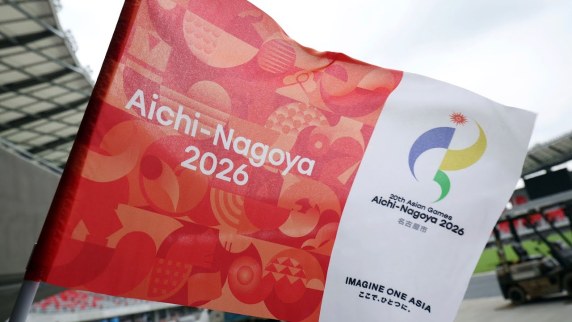
The 20th Asian Games, also known as Aichi-Nagoya 2026, will be a historic event as the games return to Japan for the first time in over 30 years. From September 19 to October 4, 2026, Nagoya and the surrounding Aichi Prefecture will transform into a global stage for 41 different sports. Whether you are a fan of high-octane athletics or the strategic depth of Esports, here is the essential roadmap for your trip.
Major Competition Schedule & Venues
To help you plan your itinerary, we’ve compiled a "What, When, and Where" table of the most anticipated events.
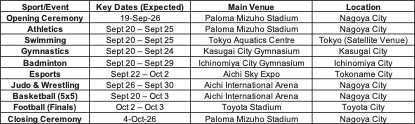
Note: Some events, like Football and Sailing, may start as early as September 10, ahead of the official Opening Ceremony.
Navigating Aichi: Transport & Logistics for Fans
Japan’s transport system is legendary, but it can be overwhelming during a mega-event like the Asian Games.
1. Arrival via Chubu Centrair International Airport (NGO)
Most international fans will land here. To get to central Nagoya, the Meitetsu μ-SKY (Mu-Sky) Limited Express is the gold standard. It whisks you to Nagoya Station in just 28 minutes.
2. The Power of the IC Card
Forget buying paper tickets for every trip. Upon arrival, grab a Manaca or Suica card. You can load these onto your iPhone or Android wallet. These cards allow you to "tap and go" on all subways, buses, and even at vending machines inside the stadiums.
3. Navigating the Subway
Nagoya has six main subway lines. The Higashiyama (Yellow) Line and Meijo (Purple) Line are the most critical for tourists. The Meijo Line is a loop line that connects major hubs like Sakae (the shopping district) and the Nagoya Dome.
Cultural Pitstops: What to Do Between Matches
You can’t visit Aichi without soaking in its rich history. The 2026 Asian Games schedule allows for plenty of "off-days" to explore:
Nagoya Castle
Reconstructed with stunning precision, the Hommaru Palace inside the castle grounds is a masterpiece of Edo-period architecture, featuring gold-leaf sliding doors and intricate carvings.
Ghibli Park
For fans of Studio Ghibli, this is a pilgrimage site. Located in the Expo 2005 Aichi Commemorative Park (which also hosts some Asian Games events), it features immersive lands like the Grand Warehouse and Dondoko Forest.
Note: Tickets must be booked 3 months in advance via the official website.
Preparing for the Trip: Weather and Currency
September in Nagoya is a transition month. You can expect warm, humid days (averaging 25°C/77°F) with the occasional chance of rain as it is the tail end of the typhoon season. Lightweight, breathable clothing is recommended for stadium seating.
While Japan is increasingly digital, "Cash is King" still holds true in smaller ramen shops and traditional shrines. However, for your digital needs—from booking Shinkansen tickets on the Smart-EX app to using Google Maps for complex subway transfers—your data connection is your lifeline.
Part 3: Why Staying Connected is Your Biggest Challenge in Japan
While Japan is a global beacon of high-tech innovation—home to the Shinkansen and cutting-edge robotics—international travelers are often surprised to find that staying connected on the move is a significant hurdle. For the 2026 Asian Games in Nagoya, where millions of fans will navigate complex stadiums and subway lines simultaneously, a "hope-for-the-best" approach to internet access is a recipe for frustration. If you plan on relying on traditional methods, you may find yourself sidelined. Here is why connectivity is your biggest challenge.
The Public Wi-Fi Myth: A Digital Mirage
Many travelers assume that a country as advanced as Japan offers seamless, open Wi-Fi. In reality,however, public Wi-Fi is often a "mirage"—visible but inaccessible when you need it most.
The Registration Nightmare: Most "free" Wi-Fi services in Japanese subways or convenience stores require a cumbersome registration process. You often need to provide an email and verify it—which is impossible if you don’t have data to begin with. Some portals are only in Japanese, turning a quick map check into a 15-minute struggle.
Stadium Congestion: Imagine being at the Paloma Mizuho Stadium for a gold-medal sprint. You try to upload a video, but the "Free Stadium Wi-Fi" is frozen. When 30,000 people hit the same router, speeds drop to a crawl. Furthermore, most Japanese public networks have strict "session limits," kicking you off every 15 minutes.
Security Risks: Open networks in high-traffic areas are prime targets for cyber-attacks. Without a private connection, your sensitive data—from social media passwords to banking info—is at risk.
The Danger of Roaming: Avoiding "Bill Shock"
Leaving your roaming on is a financial trap. International roaming is notorious for "bill shock"—the heart-stopping moment you open your phone bill to find hundreds of dollars in unexpected charges.
The $10-a-Day Drain: Many international carriers charge roughly $10 USD per day for a travel pass. For a two-week trip to the Asian Games, that’s an extra $140.
The Background Data Monster: Even if you aren't browsing, your phone is data hungry. Apps like iCloud or Google Photos perform background syncs the moment they detect a signal. In Japan, non-plan roaming rates can be astronomical. A single 5-minute background sync of your stadium videos could cost more than your dinner in Nagoya.
Throttled Speeds: Most roaming plans don't give you priority. You might pay a premium only to find your speeds "throttled" to 3G levels, making it impossible to stream the games live.
Physical SIM Limitations: The Outdated Obstacle
The "traditional" way of buying a physical SIM card at the airport is riddled with inconveniences for a major event like the Asian Games.
Airport Chaos: Landing at Chubu Centrair International Airport alongside thousands of fans means massive queues at SIM kiosks. After a long flight, the last thing you want is a 45-minute wait.
The Language Barrier: While airport staff may speak English, finding a SIM in downtown Nagoya or a local electronics store like Bic Camera is much harder. Navigating technical plans in Japanese can be a major headache.
The Risk of Loss: Swapping a physical SIM requires a paperclip and a steady hand. If you lose your "home" SIM card while swapping it out, you lose access to bank verification codes and essential texts from home.
By choosing a Japan eSIM, you bypass the registration hurdles, the high costs, and the physical mess, ensuring you stay focused on the action.
Part 4: The Ultimate Connectivity Solution: ByteSIM KDDI 5G eSIM
When the 2026 Asian Games kick off in Nagoya, the city will be buzzing with fans, athletes, and media. In this high-stakes environment, your smartphone becomes your most critical tool—not just for capturing gold-medal moments, but for navigating a foreign city in real-time. To stay ahead of the game, you need more than just "internet"; you need the ByteSIM Japan 5G Ultra Unlimited eSIM.
As the leading choice for international travelers to Japan, ByteSIM offers two flagship solutions tailored specifically for the demands of a major sporting event.
1. The Powerhouse: Japan 5G Ultra Unlimited eSIM (Powered by KDDI)
Designed for heavy data users and live-streamers, this premium KDDI (au) plan delivers an unmatched, high-speed experience that outperforms traditional roaming.
Blazing 5G Speeds (871 Mbps Max): Experience internet speeds that rival your home fiber. With a maximum speed of 871 Mbps, you can upload 4K videos of the opening ceremony in seconds.
True Unlimited Data: Unlike other providers that "throttle" your speed after a certain limit, this plan offers Always Max Speed. Whether it’s your 1st GB or your 50th, your connection remains lightning-fast.
The "Native IP" Advantage: This is a game-changer. ByteSIM uses a Native Local IP, which means your phone is treated like a local Japanese device. This results in ultra low latency (~32ms) and ensures that local apps (like Japanese taxi apps or mobile games) and streaming services like Disney+ and TikTok work perfectly without regional blocks.
99% Population Coverage: From the crowded stands of Paloma Mizuho Stadium to the high-speed Shinkansen trains between Nagoya and Tokyo, you’ll stay connected. KDDI’s network is built for stability in dense urban areas and rural landscapes alike.
2. The Versatile Choice: Dual-Network Japan eSIM (KDDI + SoftBank)
The ultimate safety net for fans traveling extensively across Japan, ensuring seamless dual-network connectivity wherever your itinerary takes you.
Dual Coverage & Auto-Switch: This plan leverages Japan’s two top award-winning networks. If you move into an area where SoftBank is stronger, your phone will automatically switch to ensure you never lose your signal.
Award-Winning Performance: SoftBank is famous for 5G Availability (keeping you on 5G longer), while KDDI au is famous for Reliability. Together, they provide an unbreakable connection for video calls and navigation.
Flexible Options: Whether you need a short-term 3-day daily plan or a large 50GB total data package, ByteSIM offers the flexibility to match your specific itinerary.
Part 5: Conclusion: Don’t Miss a Moment of the Action
As the 20th Asian Games approach, the city of Nagoya and the Aichi Prefecture are preparing to welcome the world with open arms and cutting-edge infrastructure. From the historic majesty of Nagoya Castle to the high-tech excitement of the Aichi Sky Expo, your trip to Japan in 2026 promises to be an unforgettable blend of tradition and modern spectacle.
However, a successful trip to Japan requires more than just a ticket to the stadium. It requires the peace of mind that comes with a reliable, high-speed internet connection. Whether you are navigating the intricate Nagoya subway system, translating a menu at a local izakaya, or sharing the thrill of a gold-medal victory with friends back home, your data connection is your most important travel companion.
By choosing a ByteSIM Japan eSIM, you aren't just buying data; you are securing a seamless travel experience. You can skip the long airport queues, avoid the frustration of unreliable public Wi-Fi, and protect yourself from the "bill shock" of international roaming. With the power of Japan's best 5G networks—KDDI and SoftBank—in your pocket, you can focus on what really matters: the spirit of the games.
Equip Your Phone for Nagoya Journey
Part 6: FAQ: Common Questions About Japan Travel & eSIM
Yes! The ByteSIM Japan eSIM provides nationwide coverage across all of Japan, including major cities (Tokyo, Nagoya, Osaka) and rural areas. It also works seamlessly on the Shinkansen (Bullet Train) between cities.
If you plan on using Google Maps, social media, and occasionally streaming video, we recommend an Unlimited Data Plan. If you only need it for basic navigation and messaging, 1GB to 2GB per day is usually sufficient.
While generally safer than in many countries, Japanese public Wi-Fi is still an open network. For banking or accessing sensitive work emails, we highly recommend using a private, encrypted connection like that provided by your ByteSIM eSIM.
With ByteSIM’s Unlimited plans, you never have to worry about running out. For Daily or Total data plans, you can easily top up your data through our website, and our 24/7 support team is always available to assist you.
Absolutely. Because an eSIM is a digital secondary line, your physical SIM card can stay in your phone (or be turned off), allowing you to keep your original WhatsApp, iMessage, and Telegram accounts linked to your home number while using ByteSIM for data.