
How AI Is Improving Your eSIM Experience While Traveling in 2026
Apr 30,2026 | Milo
Travel in 2026 is smoother than it used to be. You land, turn on your phone, and you’re online within minutes. No SIM cards, no airport kiosks, no awkward “do you have a pin to open this tray” moments. That’s eSIM doing its job.
And it’s everywhere now. The number of eSIM-enabled devices is expected to hit around 1.5 billion globally, growing fast year by year.
Modern Travelling Backbone
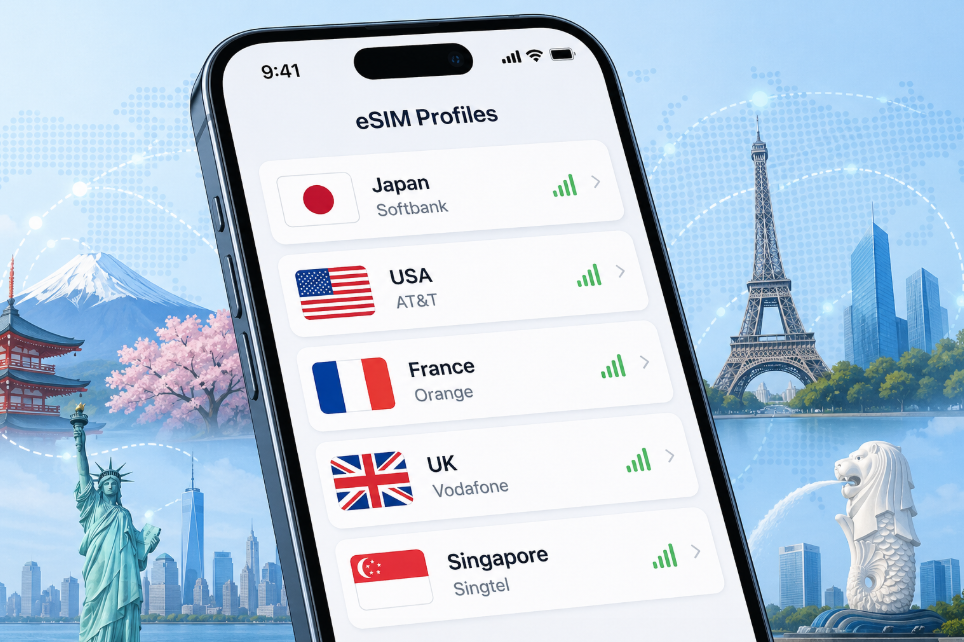
eSIM has become a cornerstone of modern travel due to:
- Instant activation across countries
- Ability to store multiple profiles
- Elimination of physical SIM handling
- Seamless switching between carriers
But here’s the part people don’t talk about much. When eSIM works, it feels invisible. When it doesn’t, it can be a real disaster.
Unlike traditional SIM cards, eSIM issues are often digital and less intuitive:
- QR code activation failures
- Network provisioning delays
- Profile conflicts between carriers
- Data plan misconfigurations
Digital Convenience Comes With Digital Problems
With physical SIM cards, things were simple. Either it worked or it didn’t. eSIM issues are more subtle and honestly more annoying. You might be connected but nothing loads. Your activation might “complete” but not actually activate. Your phone might latch onto a network that technically exists but is practically useless. And unlike before, there’s no physical fix. No swapping cards, no quick reset trick that magically solves everything.
This is exactly where customer support matters. And this is also where traditional support completely falls apart and AI software development services come in that enable smarter, faster, and more personalized support systems.
Why Old-School Support Just Doesn’t Work Anymore
Imagine landing at midnight in a new country, your data isn’t working, and your only option is:
“Submit a ticket and wait 24 hours.”
That’s not support. That’s a gamble. The reason AI is becoming essential is simple. Travelers don’t need “eventual help.” They need help immediately. And companies know it. Around 80 percent of businesses are already using or planning to use AI chatbots for support, and telecom is one of the fastest adopters.
AI Support Is Not Just Faster, It Actually Knows What’s Going On
This is where things get interesting.
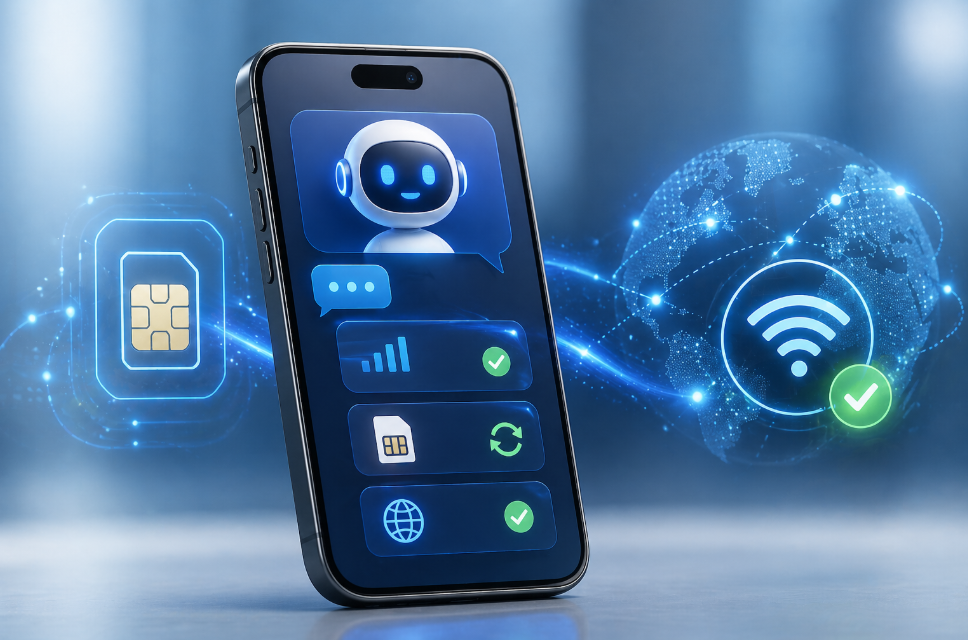
Modern AI support doesn’t just answer questions. It looks at your situation. Your phone model, your location, your network, even your past usage. So instead of getting a generic reply like “please restart your device,” you get something closer to:
“You’re connected to a network that doesn’t support your device’s bands. Switch to this one instead.”
That level of accuracy matters. AI systems today can resolve 55 to 70 percent of issues on first contact, often in under a few minutes.
Let’s make it concrete.
You land in Japan at 2AM. Your eSIM won’t be activated. No Wi-Fi, no maps, no way to order a ride. Old system: You wait. AI system: It checks your device, detects that your activation failed during provisioning, and walks you through a fix instantly. Or just fix it in the background. This isn’t hypothetical anymore. AI already handles around 42 percent of all customer service interactions globally, and that number is rising fast.
Preventing Problems Before You Notice Them
One of the more underrated changes is that AI doesn’t always wait for you to complain. It looks at patterns. If a specific carrier is having issues in a region, it can suggest switching before your connection drops. If a certain activation flow is failing for many users, it can adjust instructions in real time. That shift from reactive to proactive support is a big deal. It’s also part of why companies are investing heavily. The AI customer service market alone is worth over 15 billion dollars in 2026 and growing fast.
It Even Helps You Avoid Bad Data Plans
Picking a data plan used to be guesswork. You either overpaid or ran out at the worst moment. Now AI looks at your behavior.
If you mostly use maps, messaging, and occasional browsing, it won’t push you toward a huge plan. If you’re constantly on video calls or uploading content, it adjusts accordingly. This kind of personalization is one reason why 80 percent of users report positive experiences with AI-powered support.
AI support is not perfect. In fact, about 40 percent of users say they don’t always get satisfactory results. And most people still say they prefer humans for complex issues.
But at the same time, 75 percent of users prefer AI for simple, fast answers.
So what’s actually happening is not replacement. It’s filtering.
AI handles the boring, repetitive, time-sensitive problems. Human support handles the messy ones. That combination works better than either one alone. This is why ByteSIM balances cutting-edge technology with a human touch, offering 24/7 live human support to ensure that if the digital systems ever fall short, a real expert is always there to get you back online in minutes.
Final Thoughts
eSIM removed the physical hassle of staying connected. AI removed most of the frustration that came with it enough that being offline while traveling is starting to feel less like a normal risk and more like a rare glitch. And if you’ve ever tried to find Wi-Fi in an unfamiliar airport at 3AM, you know that’s a pretty big upgrade.
Plans that may interest you

Comment