

Local eSIM vs Roaming eSIM: Why QCI Makes Local Networks Faster
Nov 04,2025 | Milo
Table of contents
Local eSIM vs Roaming eSIM — What’s the Real Difference?
Why QCI and Local IP Matter for a Better Travel Experience
Stay Connected with ByteSIM Local eSIM
When you travel abroad, fast and stable internet can make or break your trip. Whether you’re navigating maps, video calling family, or uploading travel photos, network quality matters — and one hidden factor behind it is QCI.
Let’s unpack what QCI really means, how it affects your eSIM’s performance, and why choosing a local eSIM with a local IP can dramatically improve your connection speed.
Connect to the
fastest networks
International eSIMs, local networks. Enjoy the best of both worlds with ByteSIM.
Explore eSIMs
What Is QCI in Simple Terms?
QCI stands for Quality of Service Class Identifier, a metric used in 4G/5G mobile communication networks to differentiate the priority and service quality of data streams (bearers) for various services. It primarily ensures that different types of services within the network—such as voice, video, web browsing, and real-time gaming—receive appropriate network resources according to their specific requirements for latency, bandwidth, and reliability.
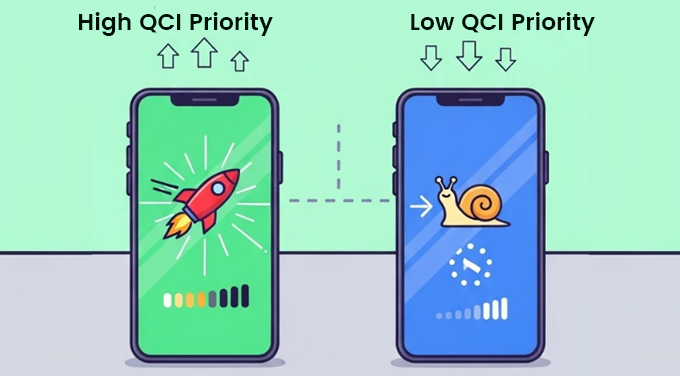
Simply speaking, QCI is like your network’s VIP level. Every type of internet activity — such as voice calls, video streaming, or file downloads — has a different priority in the mobile network.
Here’s how it works:
- A higher-priority QCI (like QCI 1–3) gets faster routing and lower latency.
- A lower-priority QCI (like QCI 8–9) waits longer in line, which means slower speeds or lag during peak hours.
Think of it like waiting for coffee — VIP customers (high QCI) get served first, while others queue up. So, when your network assigns a low QCI, you might experience lag or buffering even with good signal bars.
Local eSIM vs Roaming eSIM — What’s the Real Difference?
Most travelers assume that buying a “local eSIM” automatically gives them a fast, native network. But here’s the truth: Not all local eSIMs are truly local.
Many eSIM providers label their plans as “Local eSIMs” simply based on usage range — for example:
- Local eSIM (single country, like China)
- Regional eSIM (covers several nearby countries, like Europe)
- Global eSIM (works in multiple continents, like Global eSIM)
However, these are often still roaming networks in disguise. Even if they’re called “local,” they usually connect through foreign gateways and do not provide a local IP. That means your data may still be routed through another country, leading to slower speeds and higher latency.
Only eSIMs explicitly marked as having a “Local IP” are true local eSIMs. They connect directly to domestic carriers, use the country’s native network infrastructure, and receive higher QCI priority, resulting in faster and more stable performance.
Why QCI and Local IP Matter for a Better Travel Experience
QCI determines your network priority, while a local IP ensures your data travels through the country’s native carrier network rather than a distant roaming gateway. When both factors work together, they unlock the full potential of your mobile connection.
With a true local eSIM — one that provides a local IP and higher QCI priority — you experience:
- Faster loading speeds for websites, apps, and video streaming
- Lower latency for gaming and video calls
- Stable signal even in crowded city centers or airports
- Accurate GPS and map data, since your IP location matches your physical one
In contrast, roaming eSIMs rely on remote routing, often through another country’s servers, which adds delay and reduces connection quality. For travelers, this difference is huge:
- Instant activation upon landing
- Reliable 4G/5G speeds without random drops
- Local data rates that are far cheaper than roaming fees
- Seamless access to local apps, navigation, and streaming services
That’s why choosing a local eSIM with a local IP isn’t just about speed — it’s about enjoying a smoother, safer, and more native online experience wherever you travel.
Stay Connected with ByteSIM Local eSIM
If you’re tired of unstable connections and inconsistent speeds while traveling, ByteSIM Local eSIMs are the smart way to stay online. ByteSIM organizes its eSIMs into three main categories: Local eSIMs, Regional eSIMs, and Global eSIMs, based on their coverage range.
However, it’s important to understand that only eSIMs that include a local IP or come with a local number are genuine Local eSIMs. These connect directly to domestic operators, giving you faster speed, lower latency, and higher QCI priority — exactly like local users enjoy. Currently, ByteSIM offers true Local eSIMs in destinations such as the United States, Canada, Australia, Spain, the United Kingdom, France, Laos, Mongolia, Malaysia, Vietnam, Thailand, Japan, South Korea, Hong Kong, and so on.
These plans offer faster speeds, better stability, and higher network priority (thanks to favorable QCI levels) compared to roaming eSIMs that reroute data internationally. Whether you’re streaming, using maps, or making video calls, ByteSIM keeps you connected like a local — not a tourist on a roaming network.
Stay local, stay fast
Choose ByteSIM Local eSIMs for authentic local IP performance and smoother connectivity across various destinations.
Explore eSIMsFAQs About Local eSIMs
What’s the difference between a Local eSIM and a Roaming eSIM?
A Local eSIM connects directly to a local network using a local IP, delivering faster data speeds and lower latency. A Roaming eSIM connects through international networks, often resulting in slower speeds and less stable connections.
How can I tell if an eSIM is truly local?
On ByteSIM’s website, eSIMs that include a local IP or local number are clearly labeled on the product page — for example, Japan KDDI eSIM and Mongolia eSIM. If no local IP is mentioned, the plan operates as a roaming eSIM, even if it’s labeled “local” by region.
Why do QCI and Local IP matter together?
QCI (Quality of Service Class Identifier) defines how much priority your data gets. A Local eSIM with a local IP typically enjoys higher QCI priority, meaning faster, more consistent performance — especially in crowded areas.
Plans that may interest you