• English
  • Español
  • Français
  • 日本語
  • 한국인
  • 中文(简体)
  • 中文(繁體)
  • 올란드 제도(USD $)
  • 알바니아(USD $)
  • 안도라(USD $)
  • 호주(USD $)
  • 오스트리아(USD $)
  • 벨라루스(USD $)
  • 벨기에(USD $)
  • 보스니아 헤르체고비나(USD $)
  • 불가리아(USD $)
  • 캐나다(USD $)
  • 중국(USD $)
  • 크로아티아(USD $)
  • 키프로스(USD $)
  • 체코(USD $)
  • 덴마크(USD $)
  • 에스토니아(USD $)
  • 페로 제도(USD $)
  • 핀란드(USD $)
  • 프랑스(USD $)
  • 독일(USD $)
  • 지브롤터(USD $)
  • 그리스(USD $)
  • 건지(USD $)
  • 홍콩 특별행정구(USD $)
  • 헝가리(USD $)
  • 아이슬란드(USD $)
  • 아일랜드(USD $)
  • 맨 섬(USD $)
  • 이탈리아(USD $)
  • 일본(USD $)
  • 저지(USD $)
  • 라트비아(USD $)
  • 리히텐슈타인(USD $)
  • 리투아니아(USD $)
  • 룩셈부르크(USD $)
  • 마카오 특별행정구(USD $)
  • 북 마케도니아(USD $)
  • 몰타(USD $)
  • 몰도바(USD $)
  • 모나코(USD $)
  • 몬테네그로(USD $)
  • 네덜란드(USD $)
  • 노르웨이(USD $)
  • 폴란드(USD $)
  • 포르투갈(USD $)
  • 루마니아(USD $)
  • 러시아(USD $)
  • 산 마리노(USD $)
  • 세르비아(USD $)
  • 싱가포르(USD $)
  • 슬로바키아(USD $)
  • 슬로베니아(USD $)
  • 스페인(USD $)
  • 스발바르 & 얀 마옌(USD $)
  • 스웨덴(USD $)
  • 스위스(USD $)
  • 대만(USD $)
  • 우크라이나(USD $)
  • 영국(USD $)
  • 미국(USD $)
  • 바티칸 시국(USD $)

상관 화폐를 찾지 못했습니다

끄기

/ /

2026 Practical Guide: How to Read the Orange Holiday Europe eSIM Price and Avoid Paying for the Wrong Features

Apr 16,2026 | Wang

Table of Contents

Is the Orange Holiday Europe eSIM Price Worth Considering?

Core Answer

You might be looking up a popular Europe eSIM — but the real question isn't just “is it expensive?”

The real question is whether the features included in that price match the way you travel

Price is not the answer. Fit is the answer. The cheapest plan is not always the smartest one.

Features you do not need often become hidden overpayment.

Note: The real cost of a travel eSIM is not limited to the checkout price. It also includes whether the plan covers your route, whether it matches your usage habits, and whether it works smoothly once you land.

What Does the Orange Holiday Europe eSIM Price Actually Include?

Many people search for the word “price” as if they only want a number.

In reality, most travelers want to know what that money is buying.

In most cases, you should break the price down into five parts.

1) Data Allowance

This is the most obvious part. But do not look only at the total number of gigabytes.

You should also check whether the plan uses a fixed allowance, a daily allocation, or an Fair Usage Policy-based unlimited-use model.

2) Whether the Plan Includes a Phone Number, Calls, and SMS

This is one of the main reasons Orange Holiday can feel more expensive than some Europe travel eSIMs.

It is not always just selling data. It may also bundle a phone number, calling, and text messaging.

If you plan to contact hotels, rental car companies, or local businesses by phone, that has real value. But if you mainly use WhatsApp, WeChat, Telegram, or FaceTime Audio, the value of these extra features may be lower than the price suggests.

3) Validity Period

A 7-day plan, a 14-day plan, and a 30-day plan may look similar at first glance. Absolutely not.

Your trip length directly affects your cost efficiency. Buying a longer plan than you need is one of the most common ways travelers overspend.

4) Covered Countries

Europe” is never a complete answer on its own.

You should always confirm whether the plan includes the United Kingdom, Switzerland, Turkey, islands, and smaller territories on your route.

For background on EU roaming rules, see the European Commission’s roaming policy page.

5) Network Access and Real-World Usability

This is one of the most overlooked factors.

Some Europe eSIM products behave more like a single-brand option. Others use multi-operator access, which means they can connect to multiple partner networks across different countries or cities.

For travelers moving across borders, that can matter more than the brand name itself.

Why Do So Many Travelers Still Feel Unsure After Checking the Price?

They find a listed price, but not a decision framework.

Many travelers search the Orange Holiday Europe eSIM price and still hesitate to buy.

😰 Fear #1

Paying too much

😰 Fear #2

Choosing the wrong plan

That hesitation makes sense. Most pages show plans and prices, but do not explain what creates the price difference.

🧾 What you are really paying for (beyond data):

  • 📞 Phone number
  • 💬 SMS
  • 📶 Network access
  • ⚙️ Activation method
  • 🛠️ Support quality
  • 🗺️ Country coverage
⚠️ Hidden cost of a wrong decision
If your phone does not support eSIM, or your route includes places like the UK, Switzerland, or islands, the cost of a wrong decision can be higher than the plan itself.
🧠 Smarter approach — Don't stare at Orange Holiday's price alone.
Use the same checklist for every option:
  • 🌍 Country coverage
  • 📱 Phone number needs
  • 📡 Hotspot support
  • 🔌 Activation convenience
  • 🔄 Network flexibility across multiple countries
 

✈️ Compare facts, not just price tags

You are not choosing the cheapest digital SIM.

You are choosing the connection method that is least likely to cause problems after you arrive.

Before comparing plans, make sure your phone supports eSIM: eSIM-Compatible Device List

Which Europe eSIM Details Are Most Often Overlooked?

1) Whether the Plan Supports Automatic Activation

Some plans require more manual setup. Others start working after you arrive and turn on data roaming.

This may sound like a small detail. It is not.

For first-time eSIM users, activation convenience can make a big difference.

Automatic Activation usually means you install the eSIM before departure, then enable the line and turn on data roaming once you reach your destination.

2) Whether Hotspot Sharing Is Supported

Not every travel plan is ideal for sharing data with a laptop, tablet, or another traveler.

Hotspot sharing matters a lot for remote workers, freelancers, and travelers carrying multiple devices.

3) Whether Registration Is Required

Some travelers prefer the simplest possible setup. They do not want extra registration steps or identity friction for a short trip.

Plans with simpler purchase and activation flows are often more attractive for short stays.

4) Whether the Plan Is Data Only

Many people assume “no phone number” means “limited functionality.” That is not always true.

Data Only can be the most practical option for travelers who already rely on app-based communication.

5) Whether “Unlimited” Really Means Unlimited High Speed

This point needs to be clear from the start.

Some unlimited plans allow ongoing usage, but that does not always mean maximum speed at all times. Some daily or total-data plans continue at reduced speed after the high-speed allowance is used up.

Important Reminder: Whenever you see “Unlimited,” ask one more question: unlimited usage, or unlimited full speed? Those are not the same thing.

Source: Unsplash

How Should You Compare Orange Holiday With Other Europe eSIMs?

The safest approach is not to compare by brand name alone.

Compare by whether you will actually use the features included in the plan.

Factor Orange Holiday Europe ByteSIM
Plan Structure Often more bundled, with possible phone number, calls, and SMS Often more data-focused, though some options also include a number
Best Fit Travelers who need traditional communication features Travelers who mainly use apps for data and communication
Price Logic Usually not priced on data volume alone Often easier to match by days, data needs, and travel habits
Activation Depends on the seller and plan rules All plans support simpler or automatic activation
Hotspot Sharing Must be checked in the product details All plans clearly state whether it is supported
Multi-Country Use Depends on coverage and partner agreements Some regional plans emphasize multi-operator access across countries

Orange Holiday May Be Better If:
You clearly need a phone number, expect to use SMS or regular calls, and prefer an all-in-one plan with more traditional telecom features.

A Regional Europe eSIM May Be Better If:
You mainly need data, do not need a traditional number, will visit several countries, want hotspot support, or prefer faster setup after arrival.

This is why many multi-country travelers compare Orange Holiday with a few regional Europe eSIM options instead of treating it as the only serious choice.

Some regional products, for example, clearly state details like country count, 5G/4G LTE support, hotspot sharing, simplified activation, or no extra registration. Those details are often more useful than a vague promise that a plan “works in Europe.”

If you want a more practical overview of how to approach Europe mobile data, read: Europe Travel Internet Saving Guide

What Should You Check Before Buying and Installing a Europe eSIM?

Many travelers do not buy the wrong plan.

They install it the wrong way, or they miss one key setting.

1) Confirm That Your Device Supports eSIM

This is the first step. It is also the most commonly skipped step.

Some contract phones may still have a carrier lock. In that case, even the correct eSIM may not install properly.

2) Install the eSIM on Wi-Fi Before Departure

Installing before your flight is usually much safer than doing everything after landing.

An eSIM configuration profile is the digital plan file downloaded to your phone. In most cases, installation happens through QR code activation.

For step-by-step setup help, see: eSIM Installation Guide for iPhone and Android

3) Turn On Data Roaming After Arrival

This step confuses many first-time users.

Many travel eSIMs work across countries through regional roaming arrangements. That means you often need to enable data roaming for the eSIM line to connect properly.

For iPhone help, see Apple’s official eSIM support page.

Android users can also refer to Google Pixel’s eSIM support page.

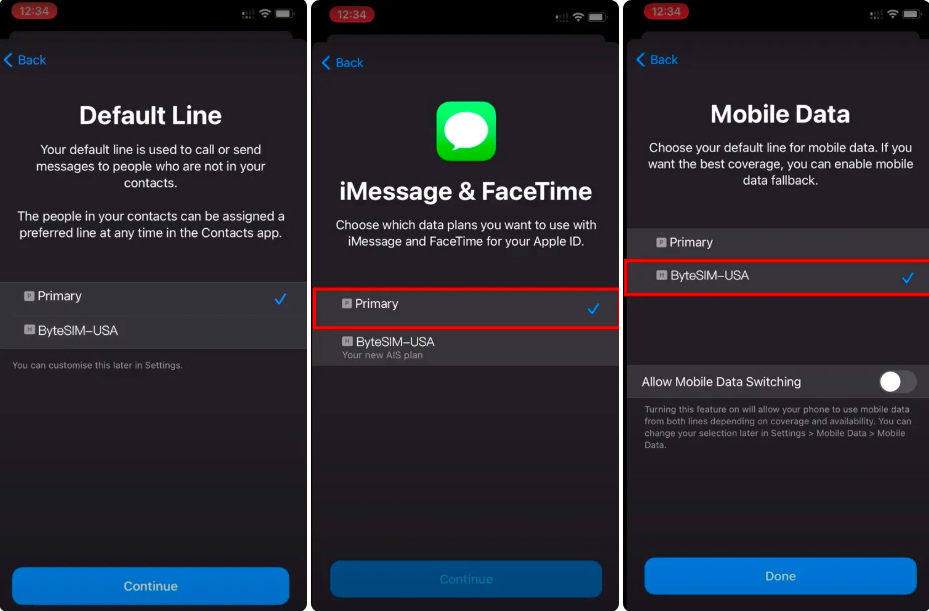
4) Check Your Default Data Line

If you keep your physical SIM and add an eSIM, confirm which line is used for mobile data.

Otherwise, you may think you are using your travel eSIM while your home SIM is still consuming expensive international roaming.

The most expensive data is often the one you turned on by mistake.

FAQS: Phone Numbers, Hotspot Sharing, Multi-Country Use, and Speed Limits

🌍 Can a Europe eSIM Usually Work Across Multiple Countries?

Usually, yes. That is one of the biggest reasons travelers buy a regional Europe eSIM in the first place.

But the plan must actually include the countries on your route. Never assume “Europe” covers every destination automatically.


💡 Always check the coverage list before purchasing — some plans cover 30+ countries, others only specific zones.

📱 Is a Data-Only Plan Inconvenient?

Not necessarily.

If you already use WhatsApp, WeChat, or Telegram for most communication, a Data Only plan may already cover almost everything you need.

A phone number is more important for travelers who need to contact hotels, rental companies, local services, or receive SMS verification.


📌 Pro tip: For occasional calls, VoIP apps (Skype, Google Voice) can supplement a data-only eSIM.

📡 Is Hotspot Sharing Really Important?

For many travelers, yes.

It matters especially for:

  • Remote work
  • Tablet navigation
  • Multi-device travel
  • Sharing data between two or more people

Hotspot support is not a small detail. It is part of the real use case.

⚠️ Many "unlimited" or budget plans restrict hotspot usage – always verify before buying.

♾️ Does "Unlimited Data" Mean Full Speed Forever?

Usually, no.

A more accurate way to read it is this: the plan may allow continuous use, but its speed policy can still change after a fair-use threshold or after a high-speed allowance is consumed.

Speed policy is one of the most important parts of a plan description, and one of the most frequently ignored.


🔍 What to check: FUP (Fair Use Policy), throttled speed (e.g., 128kbps or 512kbps), and daily high-speed cap.

🗺️ Why Do Some Travelers Care So Much About Multi-Operator Access?

Because Europe travel rarely means staying in one city the whole time.

You may take trains, cross borders, change cities, visit islands, or move through weaker coverage areas. In those situations, access to more than one partner network can improve the chance of getting a stable connection.

Multi-operator eSIMs automatically switch between networks (e.g., T-Mobile, Vodafone, Orange) to give you the best available signal — a true travel advantage.

✈️ smart roaming starts with real facts📋 always read the fair use policy

How to Judge Whether the Price Is Truly Worth It

Final Takeaway

If you want to know accurately the "Orange Holiday Europe eSIM price," remember this:

the best comparison is not about price alone.

It is about whether the plan includes the features you actually need.

Use these three questions as your shortcut:

  1. Do I need a phone number, SMS, and traditional calling?
  2. Will I travel across several countries in Europe?
  3. Will I use hotspot sharing, or do I want the fastest possible setup after arrival?

If your needs lean toward traditional telecom features, Orange Holiday is worth considering.

If your needs lean toward mobile data efficiency, flexible regional coverage, and simpler travel use, then a broader Bytesim is the smarter next step. Furthermore, its other products also include calling and texting capabilities, making ByteSIM a reliable and irresistible option.

Before you buy, write down your country list, trip length, whether you need a phone number, and whether you need hotspot sharing. That one-minute checklist will help you judge plan value much faster.

To make departure day easier, keep a few setup resources ready in advance. The eSIM Troubleshooting Guide can help you avoid last-minute setup issues. Spending a few minutes preparing at the airport is usually much easier than fixing settings after landing.

논평

성명
이메일
논평